How to Decide Between Shopify, WordPress, and Custom Websites? [2026]
![How to Decide Between Shopify, WordPress, and Custom Websites? [2026]](/_next/image?url=https%3A%2F%2Fstorage.hushupidda.com%2Fwordpress%2F2025%2F01%2FI-wonder-1.png&w=3840&q=75)
Are you asking the same question every new website owner faces: Which platform is right for my needs—Shopify, WordPress, or a custom website?
Shopify and WordPress both offer excellent user experiences for maintaining and running your website. Shopify is a fully managed platform, ideal for e-commerce, while WordPress, as an open-source CMS, excels in blogging and content management.
Custom-coded websites come into play when you need tailored solutions that aren’t achievable with Shopify or WordPress, or when their workflows don’t align with your specific requirements.
Before reading further, take a moment to consider the functionalities and design elements you want for your website.

Ease of use
A user-friendly interface is a must when managing a website. For non-technical users, designing with drag-and-drop builders and apps to integrate new features must be considered when deciding on a platform.
SHOPIFY:
Shopify is a managed platform, and it provides a great user experience. Uploading products and categories is indeed easy. Customizing web pages can be challenging for some users, but so many tutorials on YouTube can help in the process. The Shopify app store can help you enhance abilities like adding BKT: Bundle Kit to sell bundle deals as products. Themes to change the look and feel of your website.
Shopify also provides these features, which can help your business:
- Built-in analytics
- Installable apps to extend its functionalities
- International store features
- Custom delivery options
- Coupons and discounts
Shopify is a one-stop solution for your e-commerce store.
WORDPRESS:
WordPress is an open-source platform that is commonly used for blogging and publishing. Its flexibility allows you to build virtually any type of website. With thousands of plugins and themes, you can enhance its functionalities and appearance. Still unsure of its capabilities? WordPress is used by NASA, Harvard University, Microsoft, and Spotify.
These features make WordPress worth it:
- It’s a free platform, you can install and use it for free.
- Add anything like analytics, activity monitoring, or WooCommerce to start an e-commerce store.
- First-class support for blogging and publishing.
- Drag and drop builder to fully customize the website.
- integration for every popular service like Stripe, Google, Razorpay, PayPal, Mailchimp, and ConvertKit.
Every hosting provider provides a WordPress installation feature that will make your experience smooth and easier.
CUSTOM WEBSITE:
If you are a developer or can hire one, building a website for your specific needs can be beneficial, with a custom UI and workflow that can boost your business and profits. There are no limitations unlike Shopify and WordPress, you can integrate any service into your website.
These features should be considered:
- Fully custom design without any limitation.
- Connect any service into your website because custom websites do not depend on plugins.
- You don’t have to pay extra for features you need, like forms (WPForms).
- Custom functionalities like you wanting to block cash on delivery for some country or more than one, even for cities in countries.
- Custom coupons and discounts, which are not possible in Shopify and WordPress.
Operating Cost
Expenditure while running a business is important. The cost of running a website with all the services you need to attract clients is to be considered. There are various factors that can bump up your prices. It can be different for Shopify, WordPress, or a custom website.
SHOPIFY:
Shopify can be expensive depending upon your business expenditure. Prices are high because they are handling all your IT things like hosting, domain, internationalization, checkout, and for some countries shipping too. These can be difficult to manage for a non-tech-savvy person.
In India, the plan starts from ₹1,499/month and for the USA, $29/month.
Right now, for new users in India, you can get a Shopify plan for ₹20/month for the first 3 months.
WORDPRESS:
Working with WordPress can vary for one website because of its open-source nature. WordPress is free to install and use. You also get a free basic theme you can use to start a blog. But to customize WordPress, you can purchase a new theme or use a website builder to design your website. Depending upon what you use, it can differ your prices. Plus, you need a hosting server where your website lives, which can cost up to $4.59/month on Hetzener.
Example:
- Divi a website builder can be purchased for $89 for a year, there is also a lifetime plan.
- Elementor is also a website builder, you can purchase a plugin or you can pay for the hosting they provide to host your WordPress website with the plugin included.
- Themes can be purchased from Themeforest or Evanto. On Themeforest, themes start at $20. Here are a few recommendations:Astra, Neve, Kadence.
CUSTOM WEBSITE:
In most cases, operating costs while running a custom website are very low because your website is built keeping in mind those features you need to run your business. Only hosting is enough, which can cost up to $4.59/month on Hetzener.
There are some cases that can take your bills down to $1, which is the cheapest. So, you can say the operating cost of a custom website is the cheapest with all the features you need for your business.
Customization & Flexibility
Control over design marks an important feature for a website. Customization does not mean a custom coded website. Shopify and WordPress can extend features using Shopify Apps and WordPress Plugins.
SHOPIFY:
Shopify offers various native features that are powerful for sales. But these features can be extended by installing Shopify Apps. Example: Shopify doesn’t have a native feature for Wishlist.
So now you are thinking, How can I add a wishlist to my Shopify store? and the answer is Shopify Apps. Find app with good rating and reviews. Install it, and voila you have a wishlist on your website now. Having a large library of apps makes Shopify great for customization, but it also has its limit.
WORDPRESS:
Same as Shopify Apps, WordPress also has a plugins store which extends the features. But like Shopify, WordPress plugins are a complex topic: they are not all safe by default. By doing some research on which plugins to install, trusted ones. With these hiccups, WordPress also has a strong ecosystem of plugins. Example: WooCommerce is a plugin that adds e-commerce functionality in WordPress, plus it is also free to use. So as per your needs, you can customize your website by installing plugins.
CUSTOM WEBSITE:
This has maximum customizations and flexibility. Any type of flow you need for your website can be programmed. Most third-party services are built to provide integration for custom coded websites. Custom UI is the simplest example of this. It does not have the constraints of the themes that are provided by Shopify and WordPress.
What type of business you do?
If you want to run an online store, no one does it better than Shopify. But your main goal is blogging, then you can go with WordPress of its rich ecosystem for writing tools and SEO optimizations.
SHOPIFY:
If the main goal of your online store is to sell products, then Shopify inbuilt apps and services makes it easy.
- Upselling options to increase revenue of your store.
- You have abandoned cart which reminds the customers to purchase the product in cart.
- Reports to analyze the sales and customer patterns.
WORDPRESS:
Easy blogging is the main selling point of the WordPress. Its editor for writing and editing blogs is unmatched to any software. Its ecosystem of plugins enhances the capabilities of the editor.
- Yoast SEO, Rank Math are some of the tools which guides and helps the user write a SEO friendly blog.
- Ultimate Addons for Gutenberg, Kadence Blocks are plugins which helps in building complex pages without a page builder.
- Editorial Calendar helps in scheduling the blogs and plan ahead.
- EditorsKit to improve text formatting and highlighting.
CUSTOM WEBSITE:
If your use case is not fulfilled with Shopify or WordPress or you don’t want to them, you can always go with the custom websites. Custom Websites are the most flexible because it is made with your needs in mind.
Example: You want to manage your testimonials, services, client logos, FAQs. You don’t want to go to page builder because it is hectic and time consuming. A custom admin panel makes it easy and time saving.
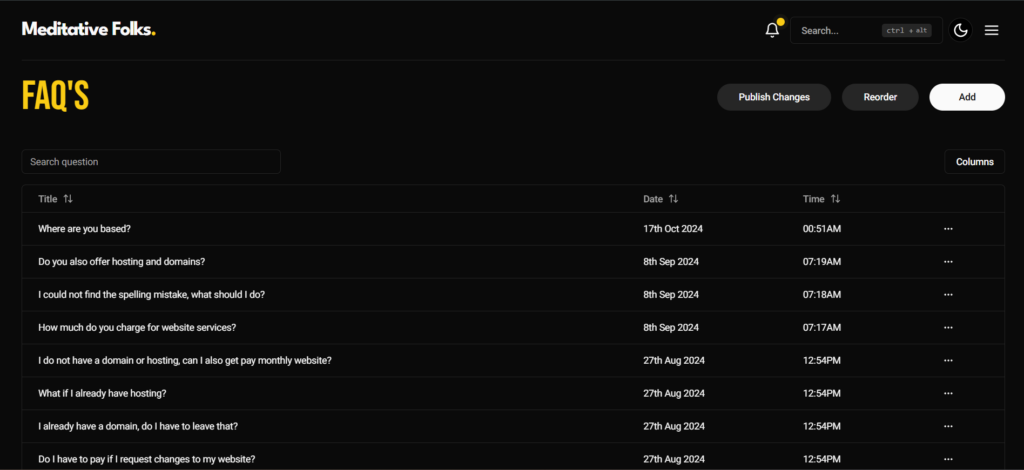
(admin panel made by Meditative Folks to manage FAQs)
CONCLUSION:
The conversation of which website is the best and what kind of website you need always start with “it depends”. Because one tool for all solutions is a myth. You can always find workaround for some tasks but that can hamper your business and workflow. This blogs paints an idea which type of website you can use to manage your business.
If you are still unsure and need a consult on which type of website you need, contact Meditative Folks ↗️.
Published on December 19, 2025
Last updated on December 19, 2025
0 Comments
Leave a Comment
Contact us for reporting a comment or any issues with the article.
No comments yet. Be the first to comment!